
BIRD OF THE MONTH - Turkey Vulture
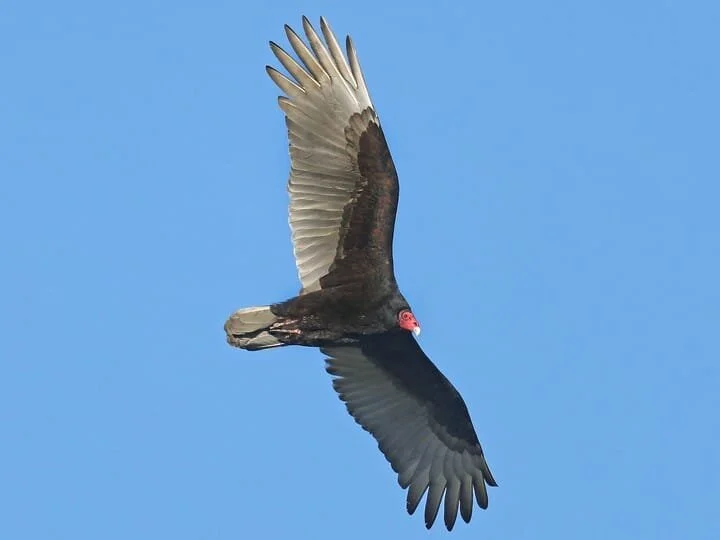
Turkey Vulture
October 2026 - Turkey Vulture
If you’ve gone looking for raptors on a clear day, your heart has probably leaped at the sight of a large, soaring bird in the distance, perhaps an eagle or osprey. But if it's soaring with its wings raised in a V and making wobbly circles, it's likely a Turkey Vulture.
These birds ride thermals in the sky and use their keen sense of smell to find fresh carcasses. They maintain stability and lift at low altitudes by holding their wings up in a slight V-shape and teetering from side to side while flying. The part of its brain responsible for processing smells is particularly large, compared to other birds and has a heightened ability to detect odors. They are skilled scavengers, cleaning up the countryside one bite at a time.
On the ground they move with ungainly hops and often they can be seen standing erect, wings spread in the sun, presumably to warm up, cool off, or dry off. By taking care of the carrion, vultures provide an essential service for the health of our ecosystems. Without them, carcasses would accumulate, and diseases would spread from rotting flesh.
They lack the vocal organs to make proper songs and most of their vocalizations come down to a form of a low, guttural hiss made when they are irritated or vying for a better spot on a carcass. As a defense mechanism, Turkey Vultures may vomit on a bird, animal, or human that gets too close. A resident to long-distance migrant and some in the southern United States are year-round residents.
Our Mission
The Loess Hills Audubon Society exists to educate individuals and the general public, to enjoy and promote birding, to support ornithology, and to be an advocate for wild areas and environmental issues.

Meetings
Loess Hills Audubon Society meets at the Dorothy Pecaut Nature Center, 4500 Sioux River Road the first Thursday of the month during the months of September through May at 7:00 P.M.